A few years ago, we featured here on Open Culture the Freedmen’s Bureau Project database, which contains searchable information on formerly enslaved people in the United States after its Civil War. With nearly 1.8 million men, women, and children registered there when it first opened to the public, it has remained a valuable resource for many Americans researching their own heritage, not just descendants of former slaves but of other Civil War refugees as well. But of course, the U.S. was hardly the only country where slavery existed. Countless people here in the twenty-first century have ancestors who were enslaved in other former British colonies, and now they’ve got a portal through which to do genealogical searches of their own.
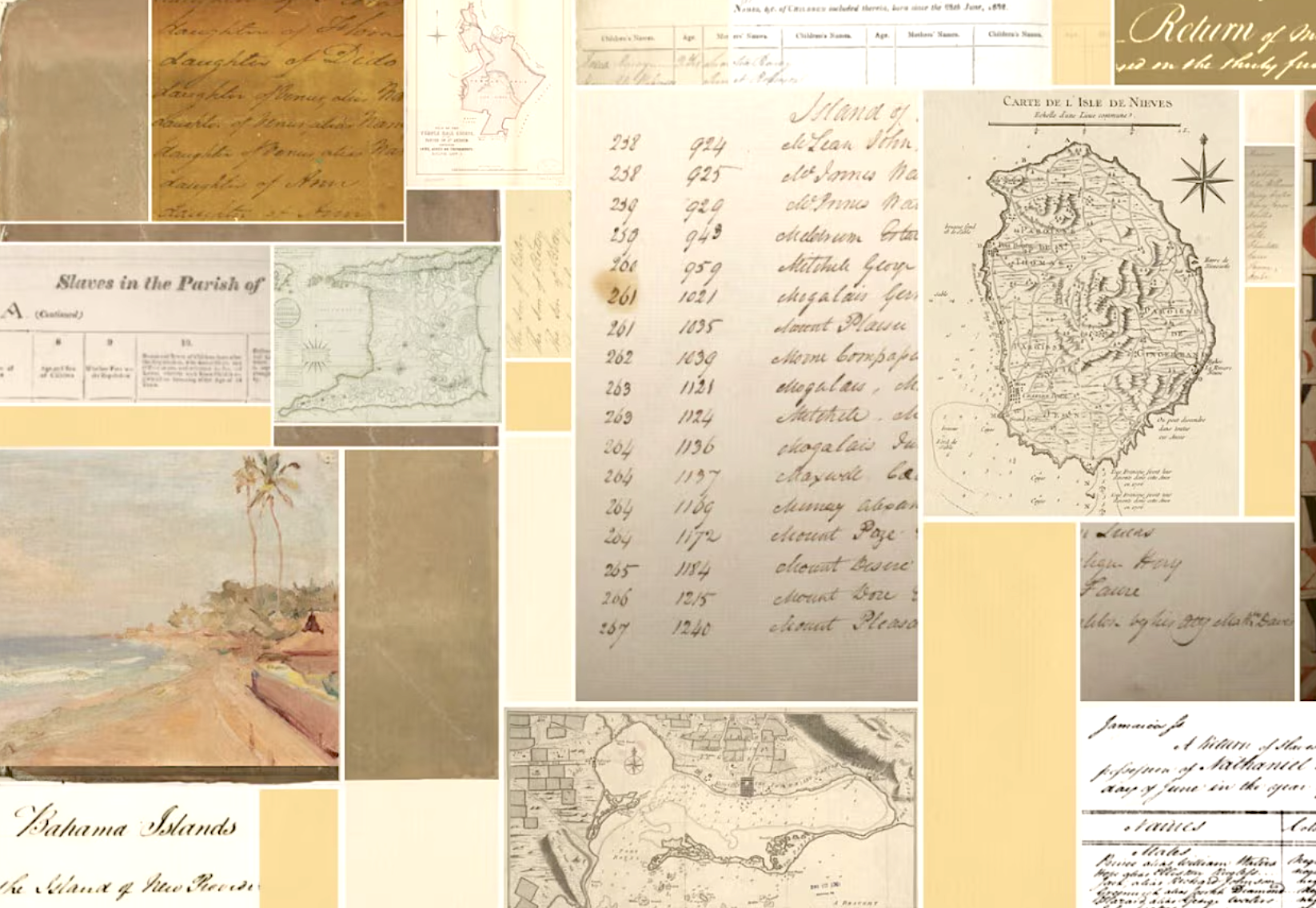
Launched by a partnership between the genealogy company Ancestry and the Centre for the Study of the Legacies of British Slavery at University College London, the online Former British Colonies Enslavement Registers makes available records on nearly four million individuals enslaved between 1813 and 1840 in a host of countries from the Bahamas to Mauritius to South Africa.
First created by the British government during the process of abolishing the transatlantic slave trade in 1807 — much as the Freedmen’s Bureau organized its registry of former slaves during Reconstruction under Abraham Lincoln — the original papers contain not just their names and ages, but also maternal family connections, physical descriptions, and sometimes details about their place of African origin.
In the video above, genealogist and Ancestry Senior Story Producer Nicka Sewell-Smith provides an introduction to the Former British Colonies Enslavement Registers, which you can access here. If you’re curious about whether your own ancestors may appear in its records, you can search by details like name, approximate date, or location to narrow down the potential matches. The modern descendants of people enslaved in the 20 countries covered by the database by no means live exclusively, or even primarily, in those countries or in Great Britain itself. More than two centuries later, their descendants live all over the world, including in Latin America and the United States, leading lives very different from those of their enslaved ancestors — but the reconstruction of their family stories has only just begun. Enter the database here.
Based in Seoul, Colin Marshall writes and broadcasts on cities, language, and culture. He’s the author of the newsletterBooks on Cities as well as the books 한국 요약 금지 (No Summarizing Korea) and Korean Newtro.Follow him on the social network formerly known as Twitter at @colinmarshall.
I am sure that many an Open Culture reader has a Bialetti Moka Express in their kitchen. I know I do, but I must add that I knew little about its history and apparently even less about how to properly use one. Coffee expert and author of The World Atlas of Coffee James Hoffmann introduces us to the appliance we think we know in the above video.
Alfonso Bialetti didn’t originally get into the coffee business. In 1919, the Bialetti company was an aluminum manufacturer, with the Moka Express invented somewhere around 1933 by Luigi de Ponti, who worked for the company. According to Deconstructing Product Design by William Lidwell and Gerry Manacsa, the inspiration came from Bialetti’s wife’s old-fashioned washing machine: “a fire, a bucket, and a lid with a tube coming out of it. The bucket was filled with soapy water, sealed with the lid, and then brought to a boil over the fire, at which point the vaporized soapy water was pushed up through the tube and expelled on to the laundry.”
As Hoffmann shows, earlier coffee-makers did use steam and a drip technique, but the Moka Express was the first all-in-one maker that could sit on the stove top and do the work. All the user had to listen for was the tell-tale gurgle when it finished brewing.
In 1945, Alfonso’s son Renato returned from a prisoner-of-war camp and took over the family business. He was instrumental in focusing on the Moka Express and turning it into an international coffee brand. He hired cartoonist Paul Campani to design l’omino coi baffi, “the mustachioed little man” whose image is on the side of every Moka Express, and who, during the 1950s, was in a series of humorous animated commercials. Bialetti was the pride of Italy, and for Italian immigrants living abroad, it was a treasured object in the kitchen.
Such was the identification of Renato Bialetti with the Moka Express that when he died in 2016, his ashes were interred in a giant replica pot. Hoffmann details the fate of the company afterwards, how it has fared against competitors in Italy and outside. Will it still be around in decades? Who knows. But it does make a great cup of coffee.
And he shows the correct way to brew a cup with the Moka Express in this other video. Here are a few things I was doing wrong: not using hot water in the bottom to start; trying to pack in the ground coffee like I was making an espresso; using too fine a grind; and not cooling the bottom as soon as it’s done working its magic. (Note: a Moka Express coffee is somewhere between an espresso and a pour-over.) All these tips I’m going to try tomorrow morning. Maybe you have been making your Bialetti cup the right way all along. Let me know in the comments. I’ll read them over a freshly brewed cup.
Note: An earlier version of this post appeared on our site in 2022.
In 2002, the retired British submarine lieutenant-commander turned amateur historian Gavin Menzies created a stir with a book about Chinese seafaring in the fifteenth century. 1421: The Year China Discovered the World (tellingly titled 1421: The Year ChinaDiscovered America in the United States) began as a global history of that year, only coming to focus on the claim of the title through the interventions of publishing-industry professionals. They no doubt sensed a lucrative controversy in the offing, and events proved them right. Not only did the book turn bestseller, it also managed the rare feat of drawing, among other responses, a two-hour PBS documentary dedicated to debunking it. Today, 1421 is most charitably remembered as a work of historical fiction written around the idea that, even if China didn’t actually discover the world, wouldn’t it be neat if it had?
That question is hardly as frivolous as it may sound. Much of Menzies’ book has to do with the exploits of Zheng He, a Ming-dynasty admiral and diplomat whose fleet really did make voyages to much of the world, or at least the parts surrounding the Indian Ocean. Even if the claim that he beat Christopher Columbus to the Americas can’t be supported, he really did get around, and in seriously impressive ships at that. In the Hoog video above, you can see Zheng He’s story told with retro 3D video-game graphics suitable to convey the kind of adventure his life became. Yet it could hardly have begun more humbly: born into a Muslim family in the southern, Mongol-controlled Yunnan province, he was captured by the Ming military and castrated in adolescence. Harsh though that sounds, it made him able to accrue a kind of power that could never have been his otherwise.
“The Ming empire was built on eunuchs,” says the video’s narrator. “Unlike other imperial Chinese dynasties, the Ming elevated castrated men beyond what any had known.” Their inability to reproduce and serve their own bloodline inspired the trust of the rulers: “What they lost in mutilation, they gained in access to power.” Under Zhu Di, known as the Yongle Emperor, Zheng He became “the most powerful eunuch in the Ming Dynasty.” In order to project his power overseas, the emperor decided to construct “the greatest fleet the world has ever seen,” consisting of 300 transport ships, 180 warships, 240 supply ships, 700 horse ships, and 36 massive “treasure ships” that might have been the largest wooden vessels ever to set sail. To lead this “moving empire” with its staff of 27,000 — many of them eunuchs — he knew no one more reliable than his old friend Zheng He.
This fleet’s expeditions maintained sufficient hegemony to ensure a period of regional stability some call the Pax Ming. At the same time, the civil service grew ever more resentful of the privileged eunuch class, and a lightning strike on the Forbidden City in 1421 was taken as a sign that the time had come to criticize their leadership. It would seem that Zhu Gaochi, the Yongle Emperor’s son, took this criticism to heart. When he took power as the Hongxi Emperor after his father died while Zheng He was at sea, he put an end to the costly naval expeditions that could, in theory, one day have reached the New World. Questions about why China’s age of maritime exploration had to end have more recently been joined by others about whether such a vast fleet really could have sailed, and for that matter, whether the enormous treasure ships could even have been built in the first place. China may have done away with the eunuch system more than a century ago, but there’s no doubt that its current leadership recognizes the importance of sea power — or that it has its eyes on the heavens.
Based in Seoul, Colin Marshall writes and broadcasts on cities, language, and culture. He’s the author of the newsletterBooks on Cities as well as the books 한국 요약 금지 (No Summarizing Korea) and Korean Newtro.Follow him on the social network formerly known as Twitter at @colinmarshall.
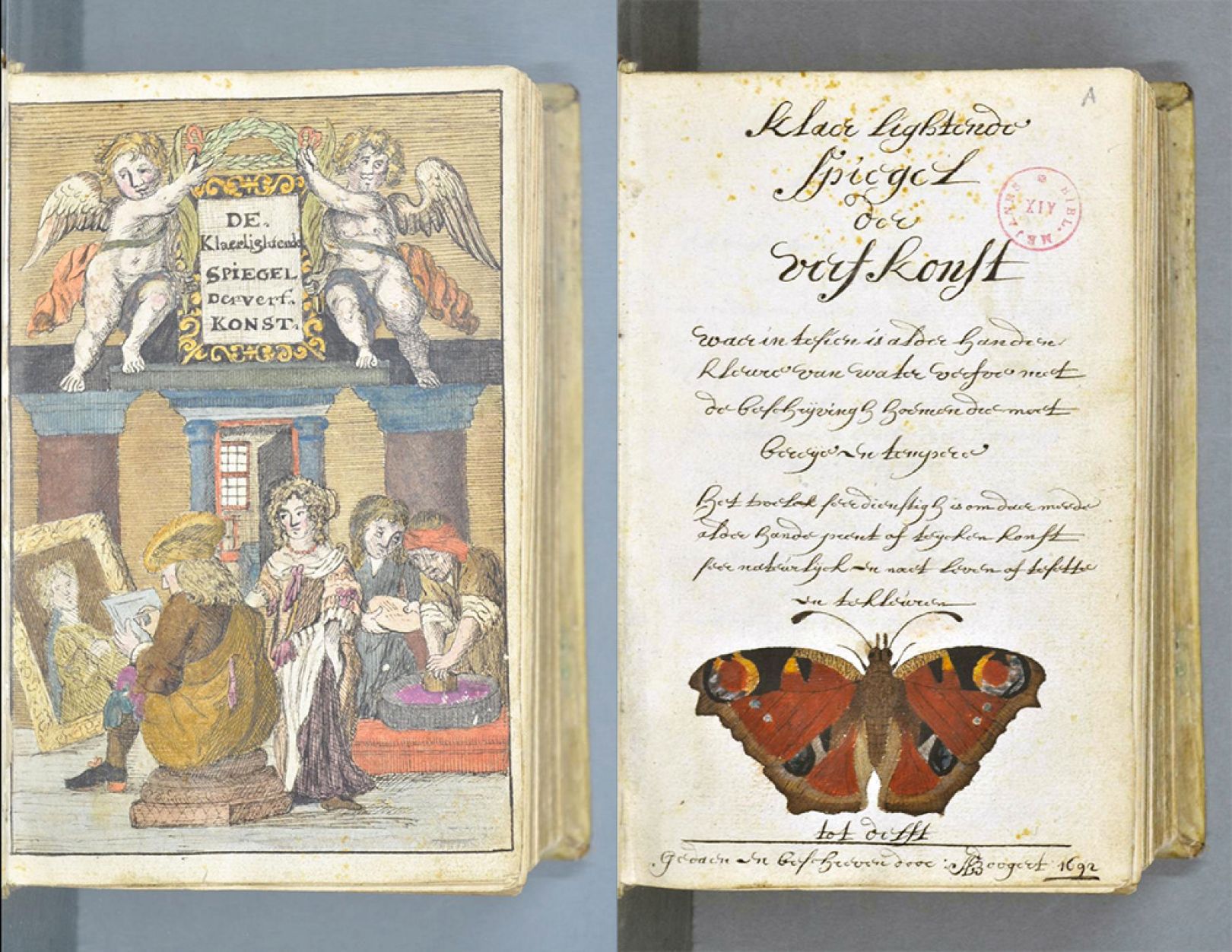
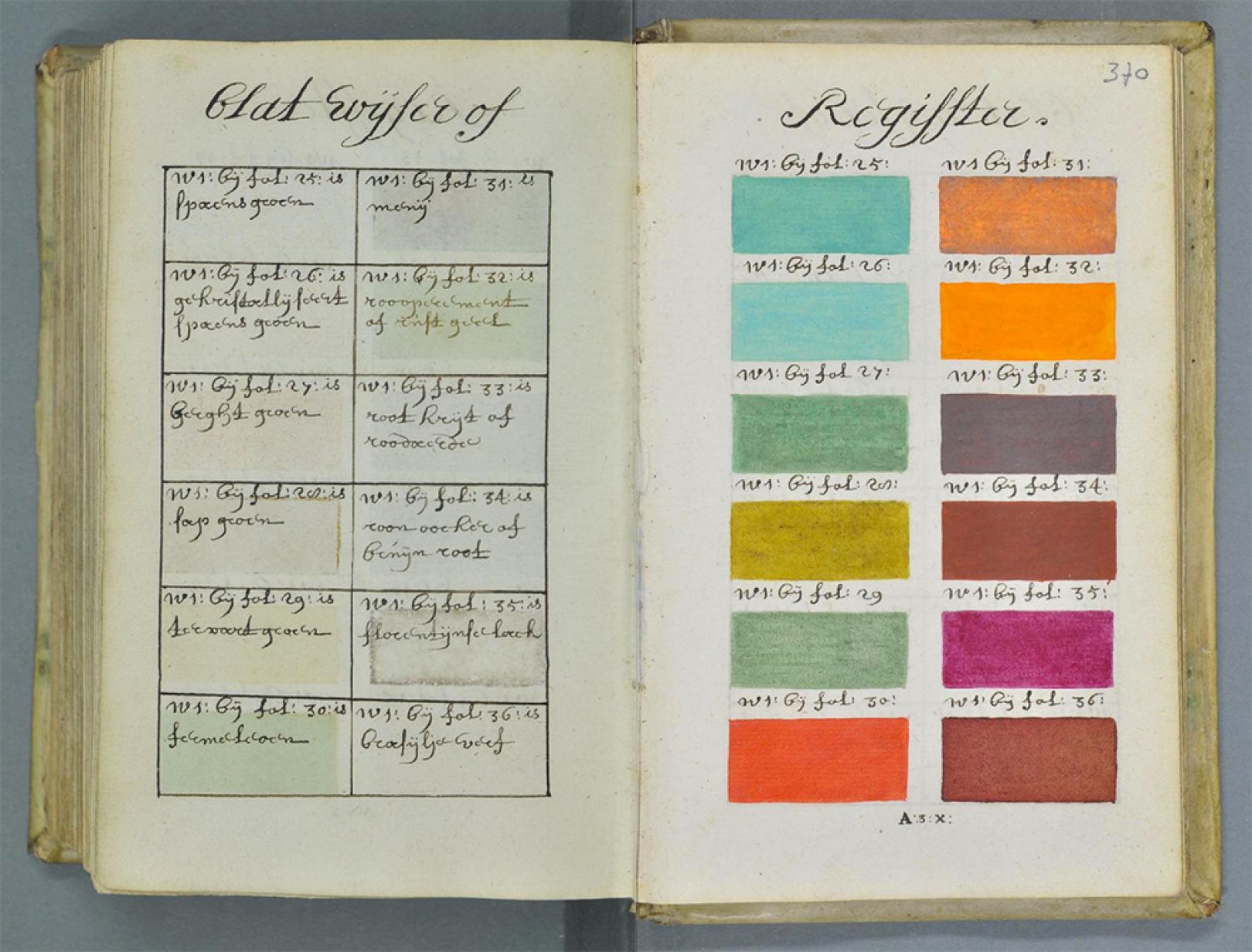
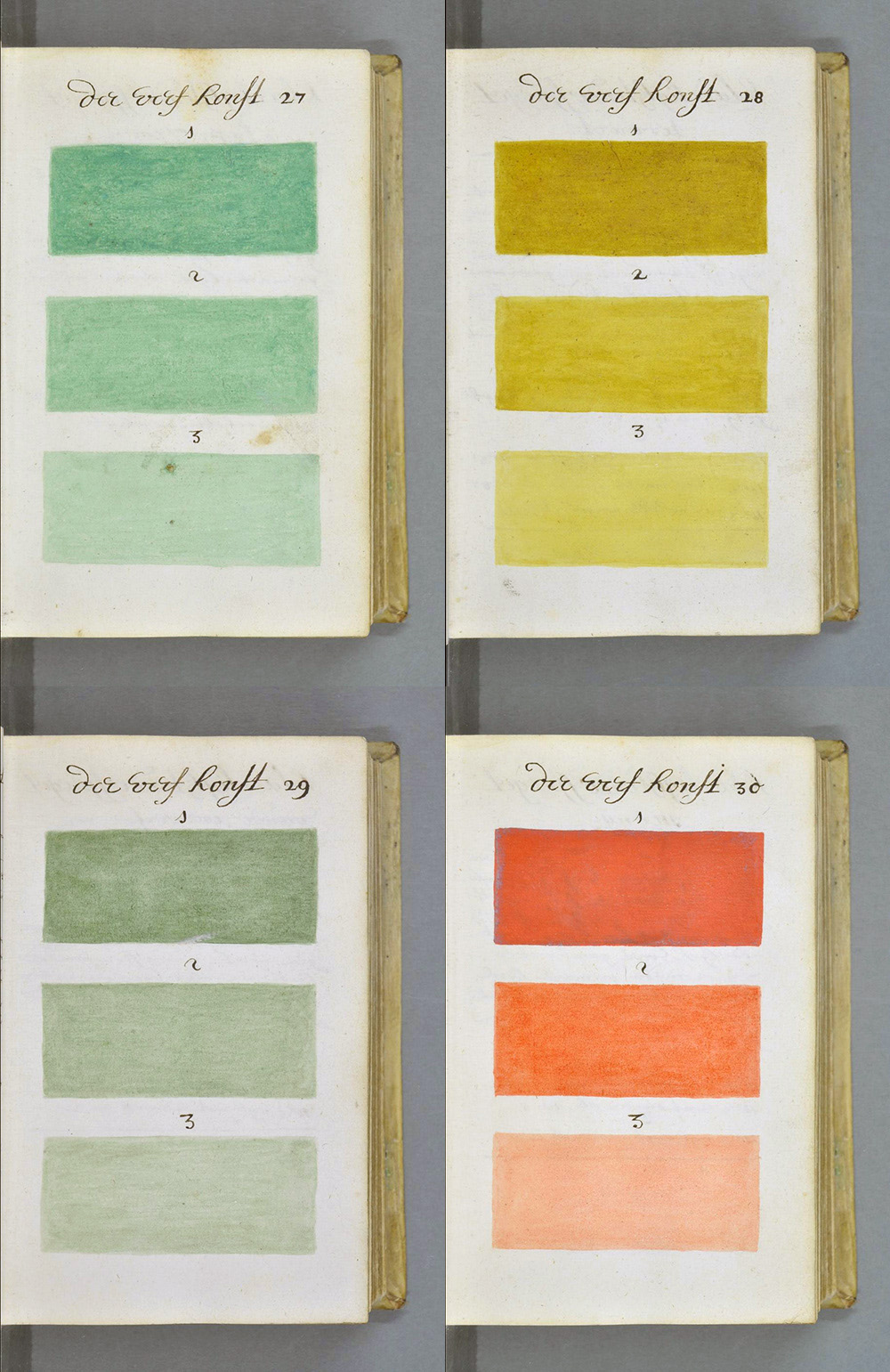
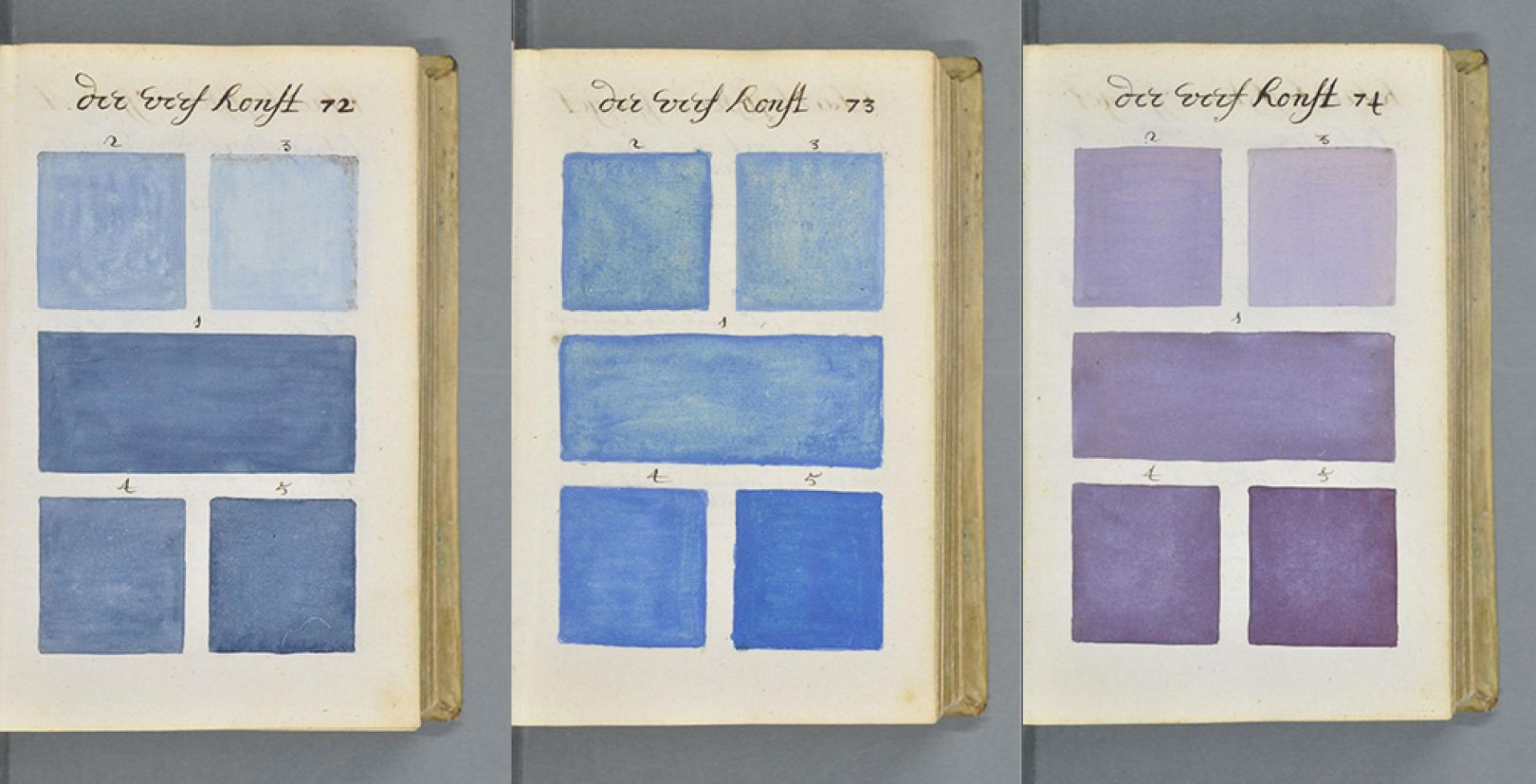
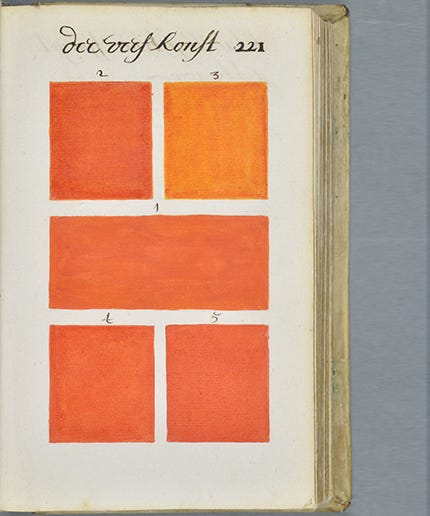
There’s ahead of its time, then there’s Traité des couleurs servant à la peinture à l’eau — or, in its original Dutch title, Klaer Lightende Spiegel der Verfkonst, a 900-page book of paint colors made before any such things were common tools of the artist’s, scientist’s, and industrial designer’s trade. Author and artist A. Boogert created one, and only one, copy of his extraordinary manual on color mixing in 1692. Appearing on the threshold of modern color theory, and featuring over 700 pages of color swatches, the book draws on Aristotle’s system of color rather than the new understanding of the color spectrum, fully elaborated by Newton in his Opticks over a decade later.
It would be another hundred years before a flood tide of color books began to make the theory more practical: from Goethe’s 1810 Theory of Colors and Werner’s 1814 Nomenclature of Colour to the dream of color standardization realized: the Pantone company, launched in 1963.
But if A. Boogert had much influence on the theory or practical application of color in his day, there doesn’t seem to be much evidence for it. Of course most of the Dutch masters had died when the book was completed, and it seems unlikely that those still working in 1692 would have been familiar with its single copy.
Instead, the book was meant to educate watercolorists, hence its French title, which refers to “water-based paint.” (A literal translation of the Dutch runs something like “clearly lighting mirror of the painting art.”) Medieval historian Erik Kwakkel found the book in a French database, “and it turns out to be quite special,” he writes, “because it provides an unusual peek into the workshop of 17th-century painters and illustrators.
In over 700 pages of handwritten Dutch, the author, who identifies himself as A. Boogert, describes how to make watercolour paints. He explains how to mix the colours and how to change their tone by adding ‘one, two or three portions of water.’… In the 17th Century, an age known as the Golden Age of Dutch Painting, this manual would have hit the right spot.”
The book is currently housed at Bibliothèque Méjanes in Aix-en-Provence, where you’ll find full-page, zoomable, hi-resolution scans. “Beyond being informational, the images from the book are stunning and addictive flip through,” notes Refinery29. “They resemble page after page of Pantone color chips, except without the household name.” One wonders if “A. Boogert” would have become a household name had his book been printed and distributed. But his color system was already passing away in the Newtonian age of color spectrums and wheels, until paint chips finally came back in style. Visit the color manual online here.
Note: An earlier version of this post appeared on our site in 2019.
David Byrne will always be most widely known as the co-founder and frontman of Talking Heads. That may count among the greatest possible achievements for any artist — to the minds of many an Open Culture reader, at least — but it must occasionally frustrate the man himself. Talking Heads broke up 35 years ago, but Byrne has only grown more and more productive since, recording his own albums, creating musicals, writing books, putting on PowerPoint presentations, and even designing bike racks. By now, his ideas have stretched so far beyond music that he’s considering the nature of ideas themselves, how they succeed or fail in catching on, and why they go in and out of acceptance over time. Hence his new book Sleeping Beauties: Why Good Ideas Go Dormant and How They Wake Up.
“I first saw the term ‘sleeping beauties’ (outside of the folktale or the Disney movie) when I went down a rabbit hole and stumbled on a paper from 2004 called “Sleeping Beauties in Science” by the scientometrics researcher Anthony van Raan at Leiden University,” Byrne writes in an excerpt of the book published online. (Scientometrics being, he adds, “the study of the impact and communication of science.”) He cites a favorite example of the astronomer Vera Rubin’s discovery, in the nineteen-seventies, of “evidence for dark matter, which is estimated to make up a large percentage of the universe.” Understanding her own observations required her to “question even her most basic assumptions — that matter must emit light and radiation. She was a visual thinker, and she used her data to create plots and sketches that revealed patterns within the numbers.”
Only decades later was Rubin’s counterintuitive vision of the universe supported by theoretical physicists and radio astronomers using ever more technologically advanced tools like “the powerful Hale Telescope, Kent Ford’s new spectrograph, and the Uhuru satellite, which tracked cosmic X‑rays.” In the Science Friday interview at the top of the post, Byrne brings up a much older, longer-sleeping beauty often featured here on Open Culture: ancient Roman concrete, the source of whose extraordinary strength and endurance was only determined a few years ago. Though especially vivid in technology and science, “this forgetting and then remembering, I knew from my own experience, wasn’t limited to academia,” he writes. “It happens in all kinds of fields and endeavors — music, art, literature, every kind of creative profession.”
As Adam Grant writes in the New York Times BookReview, the range of examples covered in Sleeping Beauties includes “how advocates reawakened Bach’s compositions and Vermeer’s paintings after one and two centuries of slumber; how technological advances rekindled theories of continental drift and black holes; how accidents resuscitated hand-washing and genetics; and how war renewed interest in the submarine and The Great Gatsby.” Making an appearance on Late Night with Seth Meyers, Byrne was asked if any of his own work has undergone a similar process of disinterest followed by rediscovery. “It’s kind of the opposite,” he replies. “There’s things that I’ve done where I go, ‘That one does not hold up that well at all’ ” — which, if the irony of cultural history continues to operate as usual, will be exactly the records the children of today’s Talking Heads fans put on most enthusiastically a few years down the line.
Based in Seoul, Colin Marshall writes and broadcasts on cities, language, and culture. He’s the author of the newsletterBooks on Cities as well as the books 한국 요약 금지 (No Summarizing Korea) and Korean Newtro.Follow him on the social network formerly known as Twitter at @colinmarshall.
Even before the success of the electric car company that now bears his name, Nikola Tesla was a widely respected historical figure. Often, that respect could be based on surprisingly scant knowledge of the man’s life and accomplishments. Didn’t he do something with electricity? Wasn’t he involved in some kind of rivalry with Thomas Edison? Wouldn’t we all be enjoying wirelessly transmitted power, too cheap to meter, if his noble, solitary efforts hadn’t been thwarted by the establishment? Well, perhaps. Whatever dramatic satisfactions we find in Tesla’s story, we can only gauge his genius by surveying his actual inventions, four of which are explained in the new Lost in Time video above.
Tesla lived from 1856 to 1943, a period of such great technological change that, when he demonstrated a radio-controlled boat in an early phase of his career, some of the onlookers “were absolutely convinced that there was a trained monkey inside the boat, reading his hand signals.” The year was 1898, when the very idea of wireless control hadn’t entered anyone’s mind — but Tesla already foresaw a world of “vehicles that drive themselves, machines doing real work from thousands of kilometers away, and aircraft flown from a distance.” He may have been a tad early to that game, but his invention of the alternating current power system and the induction motor happened right on time.
At the end of the nineteenth century, “the race to get electricity to every household in America” was getting into gear. Thomas Edison’s direct current (DC) system technically worked, but would need a very large number of power stations to move power all over the continent. Tesla did his work on AC as a kind of correction to the shortcomings of DC, drawing what history remembers as a merciless negative-publicity campaign from Edison’s side. But none of its often-gruesome stunts meant to associate Tesla’s invention with death were a match for the success of AC’s implementation in the new power plant at Niagara Falls. More than 130 years later, AC has long powered the vast majority of homes. But if history had gone differently, the Tesla enthusiast can’t resist asking, would your house also be equipped with its own death ray?
In 1934, at one of his annual press conferences, the 78-year-old Tesla announced that he’d come up with his most important invention yet, a weapon so powerful that it could “end all wars.” Called ‘teleforce,’ it would fire beams so concentrated and energetic that they could destroy any target instantaneously upon contact. When he died in 1943, Tesla didn’t even leave sufficient documentation to tell whether the thing could have worked. He’d made slightly more progress on Wardenclyffe Tower, meant as a proof of concept for his grander vision of turning the Earth into a giant battery, filling it with electricity into which all humanity could tap at will. Industrialist J. P. Morgan had been footing the project’s bill, but cut off funding when it came out that the ever-ambitious Tesla really intended to build much more than what he’d promised, a wireless communication system — which, at that time, would have seemed like a pretty fantastical notion in itself.
Based in Seoul, Colin Marshall writes and broadcasts on cities, language, and culture. He’s the author of the newsletterBooks on Cities as well as the books 한국 요약 금지 (No Summarizing Korea) and Korean Newtro.Follow him on the social network formerly known as Twitter at @colinmarshall.
There may be no more a macabrely misogynistic sentence in English literature than Edgar Allan Poe’s contention that “the death… of a beautiful woman” is “unquestionably the most poetical topic in the world.” (His perhaps ironic observation prompted Sylvia Plath to write, over a hundred years later, “The woman is perfected / Her dead / Body wears the smile of accomplishment.”) The sentence comes from Poe’s 1846 essay “The Philosophy of Composition,” and if this work were only known for its literary fetishization of what Elisabeth Bronfen calls “an aesthetically pleasing corpse”—marking deep anxieties about both “female sexuality and decay”—then it would indeed still be of interest to feminists and academics, though not perhaps to the average reader.
But Poe has much more to say that does not involve a romance with dead women. The essay delivers on its title’s promise. It is here that we find Poe’s famous theory of what good literature is and does, achieving what he calls “unity of effect.” This literary “totality” results from a collection of essential elements that the author deems indispensable in “constructing a story,” whether in poetry or prose, that produces a “vivid effect.”
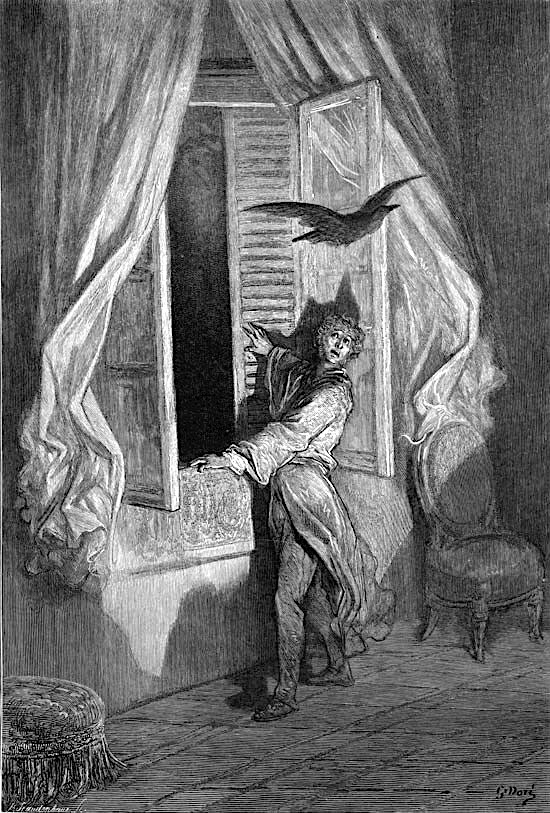
To illustrate what he means, Poe walks us through an analysis of his own work, “The Raven.” We are to take for granted as readers that “The Raven” achieves its desired effect. Poe has no misgivings about that. But how does it do so? Against commonplace ideas that writers “compose by a species of fine frenzy—an ecstatic intuition,” Poe has not “the least difficulty in recalling to mind the progressive steps of any of my compositions”—steps he considers almost “mathematical.” Nor does he consider it a “breach of decorum” to pull aside the curtain and reveal his tricks. Below, in condensed form, we have listed the major points of Poe’s essay, covering the elements he considers most necessary to “effective” literary composition.
Know the ending in advance, before you begin writing.
“Nothing is more clear,” writes Poe, “than that every plot, worth the name, must be elaborated to its dénouement before any thing be attempted with the pen.” Once writing commences, the author must keep the ending “constantly in view” in order to “give a plot its indispensable air of consequence” and inevitability.
Keep it short—the “single sitting” rule.
Poe contends that “if any literary work is too long to be read at one sitting, we must be content to dispense with the immensely important effect derivable from unity of impression.” Force the reader to take a break, and “the affairs of the world interfere” and break the spell. This “limit of a single sitting” admits of exceptions, of course. It must—or the novel would be disqualified as literature. Poe cites Robinson Crusoe as one example of a work of art “demanding of no unity.” But the single sitting rule applies to all poems, and for this reason, he writes, Milton’s Paradise Lost fails to achieve a sustained effect.
Decide on the desired effect.
The author must decide in advance “the choice of impression” he or she wishes to leave on the reader. Poe assumes here a tremendous amount about the ability of authors to manipulate readers’ emotions. He even has the audacity to claim that the design of the “The Raven” rendered the work “universally appreciable.” It may be so, but perhaps it does not universally inspire an appreciation of Beauty that “excites the sensitive soul to tears”—Poe’s desired effect for the poem.
Choose the tone of the work.
Poe claims the highest ground for his work, though it is debatable whether he was entirely serious. As “Beauty is the sole legitimate province of the poem” in general, and “The Raven” in particular, “Melancholy is thus the most legitimate of all poetical tones.” Whatever tone one chooses, however, the technique Poe employs, and recommends, likely applies. It is that of the “refrain”—a repeated “key-note” in word, phrase, or image that sustains the mood. In “The Raven,” the word “Nevermore” performs this function, a word Poe chose for its phonetic as much as for its conceptual qualities.
Poe claims that his choice of the Raven to deliver this refrain arose from a desire to reconcile the unthinking “monotony of the exercise” with the reasoning capabilities of a human character. He at first considered putting the word in the beak of a parrot, then settled on a Raven—“the bird of ill omen”—in keeping with the melancholy tone.
Determine the theme and characterization of the work.
Here Poe makes his claim about “the death of a beautiful woman,” and adds, “the lips best suited for such topic are those of a bereaved lover.” He chooses these particulars to represent his theme—“the most melancholy,” Death. Contrary to the methods of many a writer, Poe moves from the abstract to the concrete, choosing characters as mouthpieces of ideas.
Establish the climax.
In “The Raven,” Poe says, he “had now to combine the two ideas, of a lover lamenting his deceased mistress and a Raven continuously repeating the word ‘Nevermore.’” In bringing them together, he composed the third-to-last stanza first, allowing it to determine the “rhythm, the metre, and the length and general arrangement” of the remainder of the poem. As in the planning stage, Poe recommends that the writing “have its beginning—at the end.”
Determine the setting.
Though this aspect of any work seems the obvious place to start, Poe holds it to the end, after he has already decided why he wants to place certain characters in place, saying certain things. Only when he has clarified his purpose and broadly sketched in advance how he intends to achieve it does he decide “to place the lover in his chamber… richly furnished.” Arriving at these details last does not mean, however, that they are afterthoughts, but that they are suggested—or inevitably follow from—the work that comes before. In the case of “The Raven,” Poe tells us that in order to carry out his literary scheme, “a close circumscription of space is absolutely necessary to the effect of insulated incident.”
Throughout his analysis, Poe continues to stress—with the high degree of repetition he favors in all of his writing—that he keeps “originality always in view.” But originality, for Poe, is not “a matter, as some suppose, of impulse or intuition.” Instead, he writes, it “demands in its attainment less of invention than negation.” In other words, Poe recommends that the writer make full use of familiar conventions and forms, but vary, combine, and adapt them to suit the purpose of the work and make them his or her own.
Though some of Poe’s discussion of technique relates specifically to poetry, as his own prose fiction testifies, these steps can equally apply to the art of the short story. And though he insists that depictions of Beauty and Death—or the melancholy beauty of death—mark the highest of literary aims, one could certainly adapt his formula to less obsessively morbid themes as well.
Note: An earlier version of this post appeared on our site in 2015.
If you’re trying to understand a city, its map isn’t a bad place to start. Today, of course, we can call up an accurate map of practically any part of any city at any time we like, with detailed point-to-point directions available on command. Turn on the satellite view, street view, or 3D mode with its offer of every imaginable point of view, and you soon feel you’re engaging with less a representation of the city than the city itself. Yet the familiarity this makes us feel we possess is deceptive, a realization that comes afresh whenever our phone runs out of battery, leaving us barely able to find our way through even neighborhoods we’d thought we knew. Sheer habit can get us between the places we frequent, but that’s a far cry indeed from understanding the city as a whole.
That last is just what YouTuber Daniel Steiner attempts to do in his series of map explainers, which draws connections between the large-scale, abstracted view of the map and the concrete experience down on the street. He not only uses maps both current and historical to illuminate why the street network and neighborhood boundaries of a given city have taken the shape they have, but actually travels to that city and meets with experts equipped to point out physical traces of that process of urban evolution that escape the attention of most locals.
Those could be the infrastructural remnants of Roman London (or rather Londinium); the unloved Tokyo overpass where the major roads of old Japan once converged; the surveyor’s rod from the original gridding of Manhattan sticking out of what’s now Central Park; or the contours of Amsterdam even before its famous canals went in.
One visit to a city, of course, can hardly an understanding make. Steiner has so far returned to New York to create additional videos focusing on Broadway, Brooklyn, the Bronx, and Staten Island, and his examination of Los Angeles ends with a call for requests for more subjects to cover within the vast oddity of the southern California metropolis. His map explainers on other American cities from Chicago to Seattle to Savannah, Georgia also show great potential for follow-ups, to say nothing of how deep he could get into Mexico City after having told the story of how it used to be a lake. Part of these cities’ appeal lies in the fact that, no matter how long you spend in them, you can never get to know them completely, irresistible though it is to try. To the question of whether that attempt is best made top-down or bottom-up, Steiner’s videos respond implicitly — and convincingly — why not both?
Based in Seoul, Colin Marshall writes and broadcasts on cities, language, and culture. He’s the author of the newsletterBooks on Cities as well as the books 한국 요약 금지 (No Summarizing Korea) and Korean Newtro.Follow him on the social network formerly known as Twitter at @colinmarshall.
We can find serious scientific answers to this question, depending on what we mean by “world” and “end.” If we mean the end of civilization as we currently know it, climate scientists’ worst-case scenario points toward somewhere around 2100 as the beginning of the end. (New York magazinepoints out that it “probably won’t kill all of us”). It’s possible, but not inevitable.
If we mean the end of all life on earth, the forecast looks quite a bit rosier: we’ve probably got about a billion years, writes astrophysicist Jillian Scudder, before the sun becomes “hot enough to boil our oceans.” Still not a cheerful thought, but perhaps many more creatures will take after the tardigrade by then. That’s not even to mention nuclear war or the epidemics, zombie and otherwise, that could take us out.
But of course, for a not inconsiderable number of people, the question of the world’s end has nothing to do with science at all but with eschatology, that branch of theological thought concerned with the Apocalypse.
Theological thinkers have written about the Apocalypse for hundreds of years, and the world’s end was frequently perceived as just around the corner for many of the same reasons modern secular people feel apocalyptic dread: disease, natural disasters, wars, rumors of wars, imperial power struggles, uncomfortably shifting demographics….
Take 15th-century Europe, when “the Apocalypse weighed heavily on the minds of the people,” as Betsy Mason and Greg Miller write at the National Geographic blog All Over the Map: “Plagues were rampant. The once-great capital of the Roman empire, Constantinople, had fallen to the Turks. Surely, the end was nigh.”
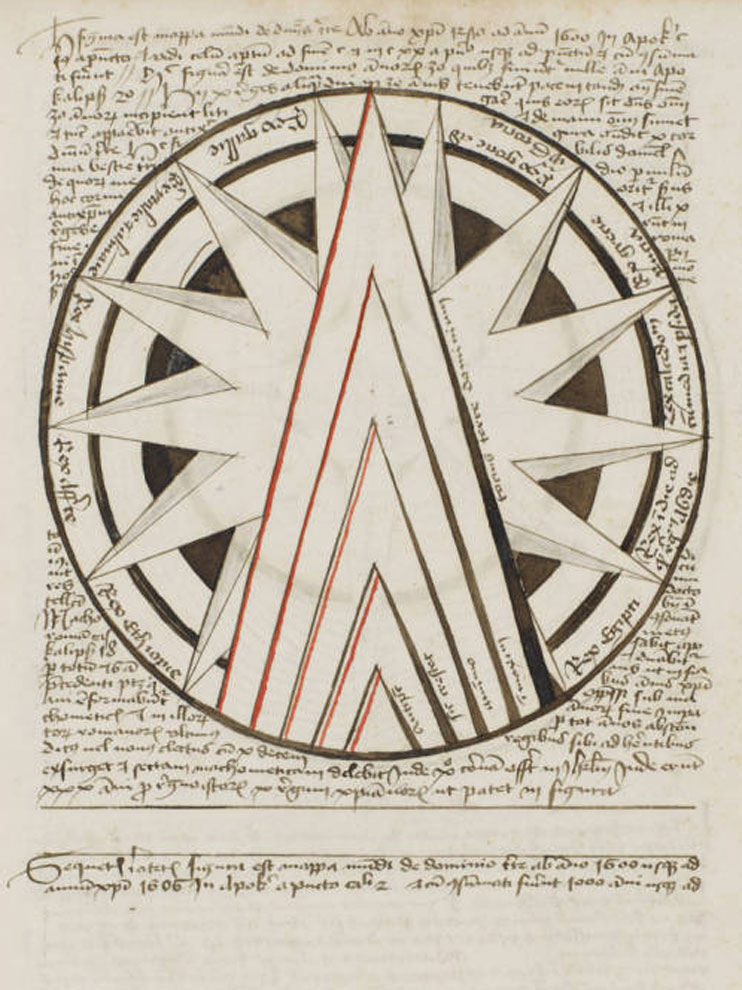
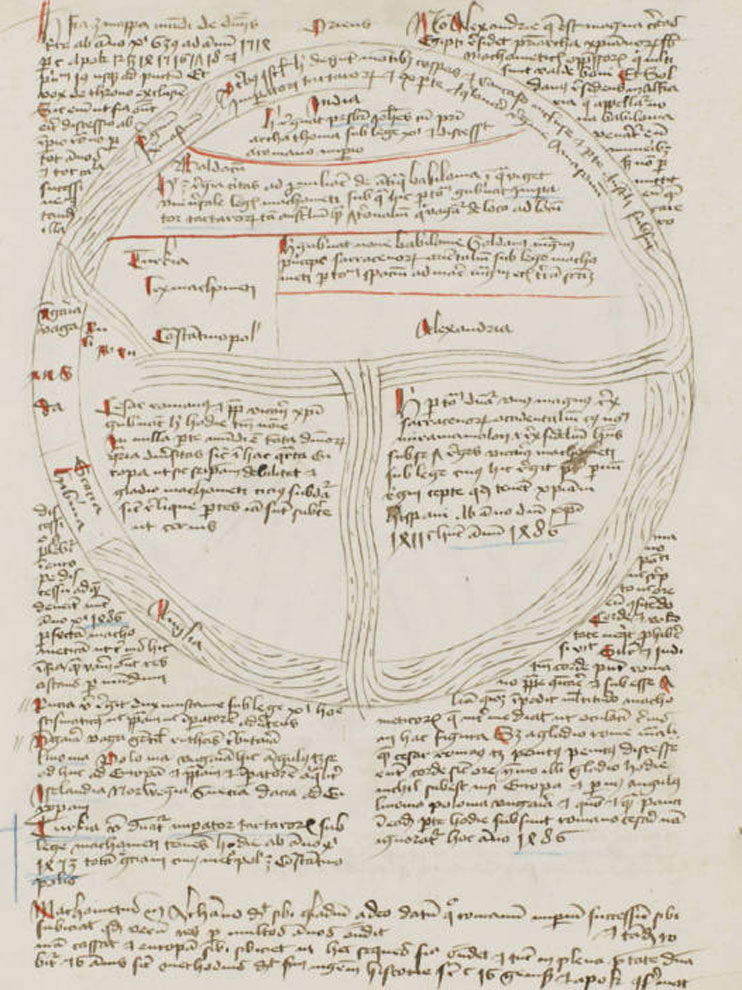
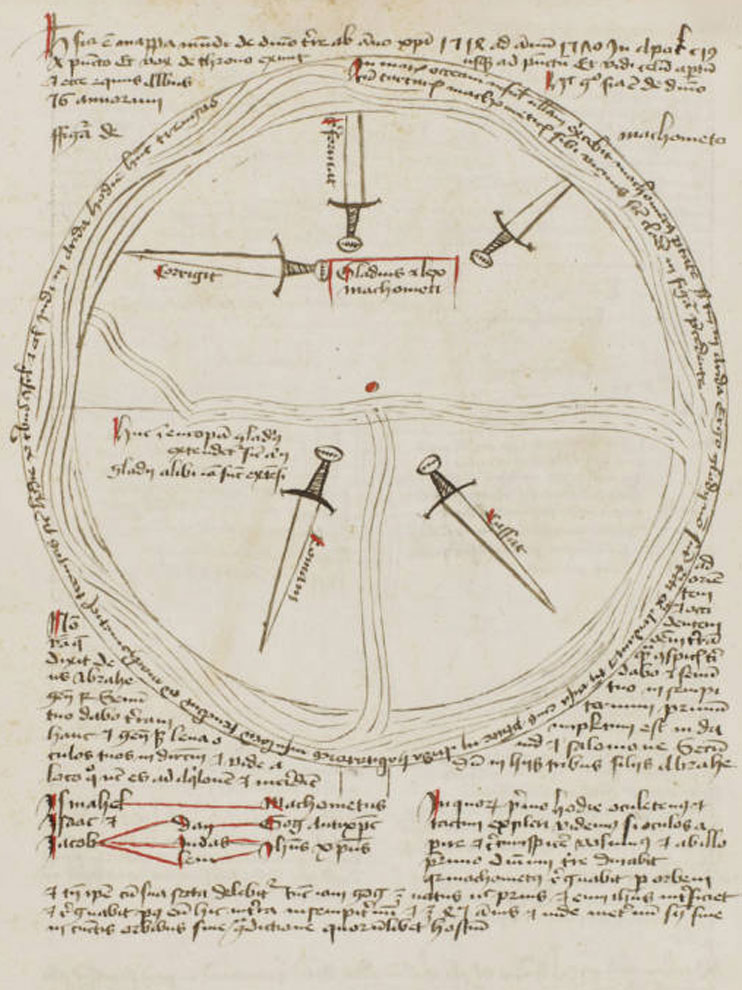
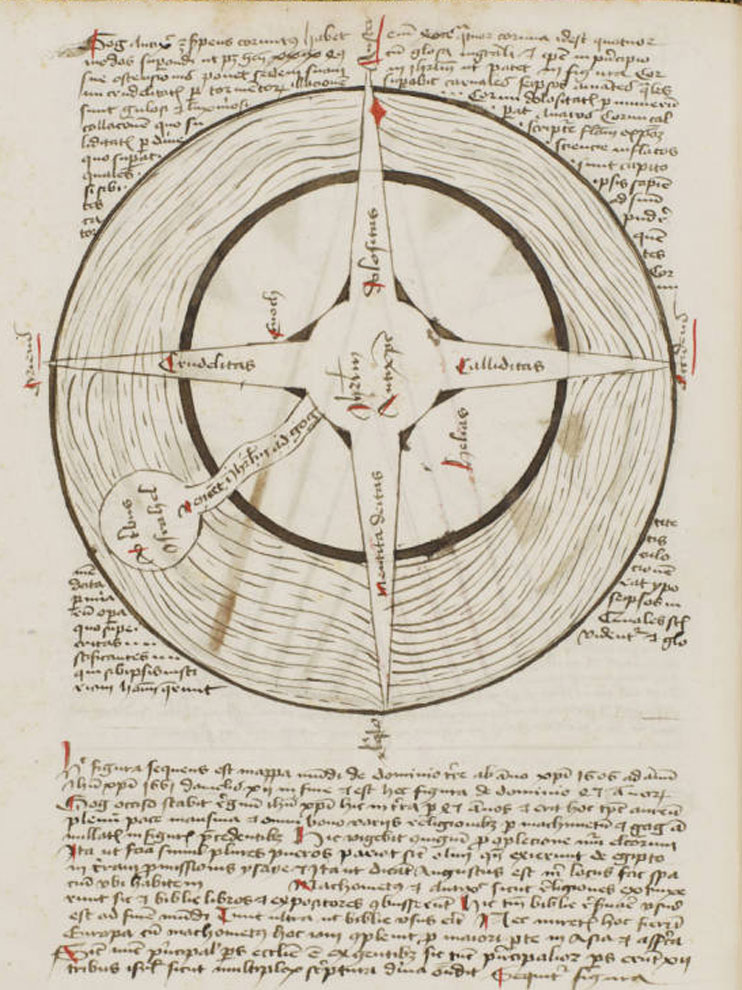
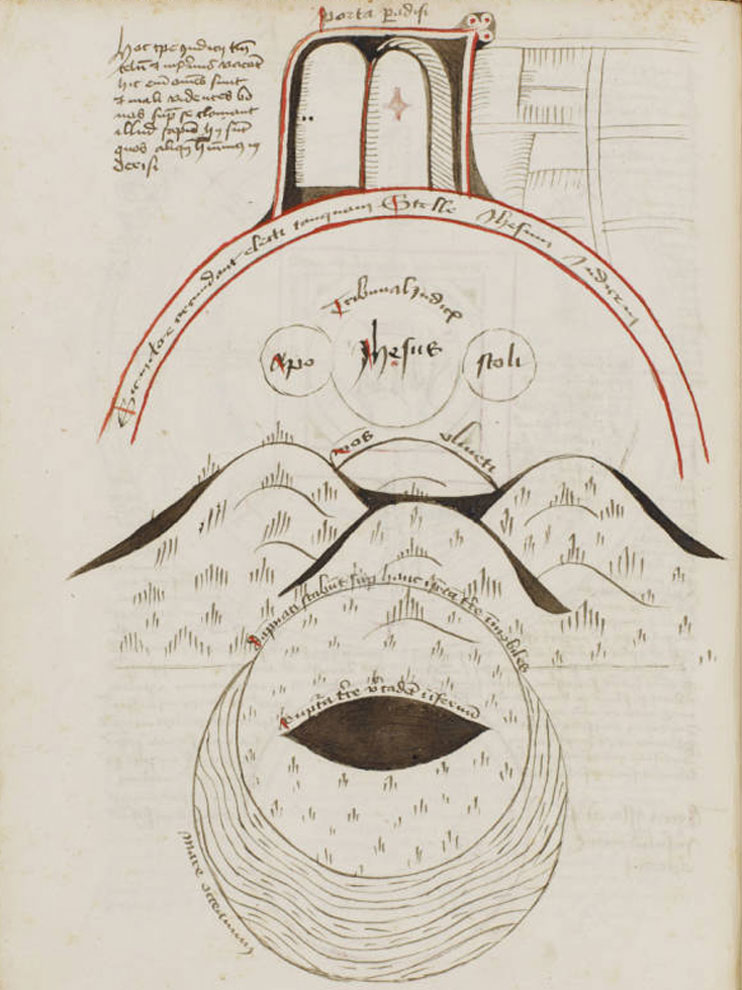
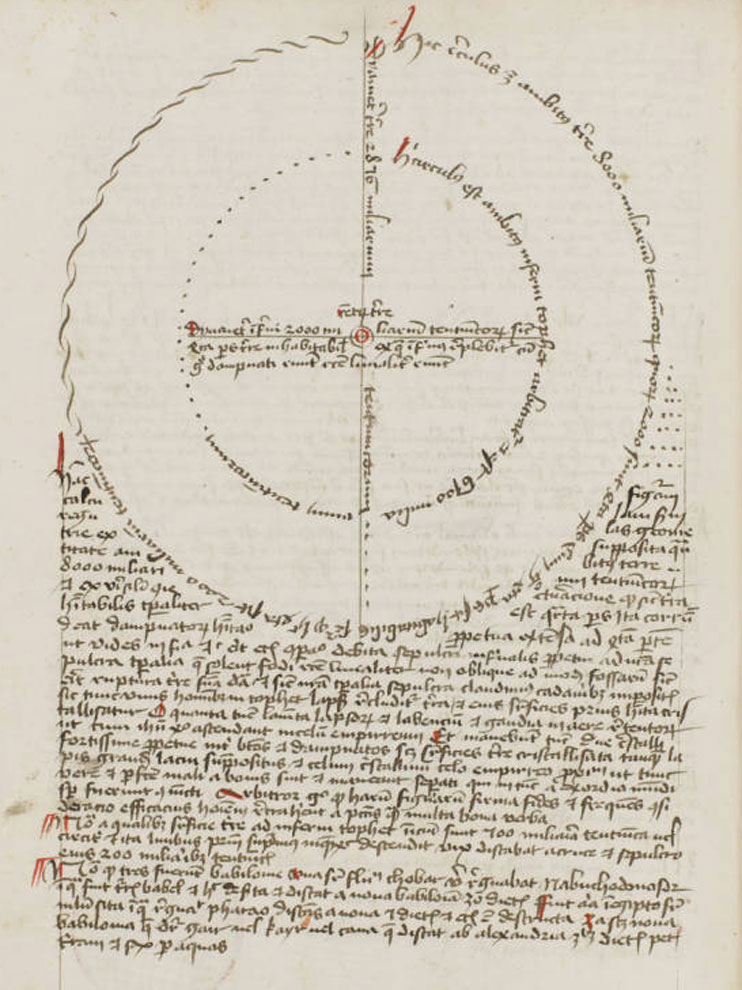
While a niche publishing market in the nascent print era produced “dozens of printed works” describing the “coming reckoning in gory detail… one long-forgotten manuscript depicts the Apocalypse in a very different way—through maps.” As you can see here, these maps convey the unfolding of worse-to-worser scenarios in a number of visual registers: temporal, symbolic, geographic, thematic, etc.
At the top, the nested triangles depict the rise of the Antichrist between the years 1570 and 1600. The central concern for this author was the supposed global threat of Islam. Thus, the next map, its “T” shape a common Medieval world map device, shows the world before the Apocalypse, the text around it explaining that “Islam is on the rise from 639 to 1514.”
Then, we have a circular map with five swords pointing at the edges of the known world, illustrating the author’s contention that Islamic armies would reach the edges of the earth. The other maps depict the “four horns of the Antichrist,” above, Judgement Day, below, (the black eye at the bottom is the “black abyss that leads to hell”), and, further down, a diagram describing “the relative diameters of Earth and Hell.”
Made in Lübeck, Germany sometime between 1486 and 1488, the manuscript is written in Latin, “but it’s not as scholarly as other contemporary manuscripts,” write Mason and Miller, “and the penmanship is fairly poor.” Historian of cartography Chet Van Duzer explains that “it’s aimed at the cultural elite, but not the pinnacle of the cultural elite.”
Pointing out the obvious, Van Duzer says, “there’s no way to escape it, this work is very anti-Islamic,” a widespread sentiment in medieval Europe, when the “clash of civilizations” narrative spread its roots deep in certain strains of Western thinking. This particular text also “includes a section on astrological medicine and a treatise on geography that’s remarkably ahead of its time.”
Van Duzer and Ilya Dines have studied the rare manuscript for its insightful passages on geography and cartography and published their research in a book titled Apocalyptic Cartography. For all its theological alarmism, the manuscript is surprisingly thoughtful when it comes to analyzing its own formal properties and perspectives.
Mason and Miller note that “the author outlines an essentially modern understanding of thematic maps as a means to illustrate characteristics of the people or political organization of different regions.” As Van Duzer puts it, “this is one of the most amazing passages, to have someone from the 15th century telling you their ideas about what maps can do.” This marks the work, he claims in the introduction to Apocalyptic Cartography, as that “of one of the most original cartographers of the period.”
The Apocalypse Map now resides at the Huntington Library in Los Angeles.
Note: An earlier version of this post appeared on our site in 2018.
High culture and new technology have never been a natural pairing. As our digital era has often underscored, media innovations tend to be adopted earliest to deliver the most puerile, sensation-driven content, with the more respectable stuff benefiting only later. When the BBC was introducing color broadcasting in the mid-nineteen-sixties, for instance, it was used for the likes of Thunderbirds, The Avengers, and The Benny Hill Show, respectable though those programs may now seem compared to what mainstream television would become in later decades. No color production of that period aimed quite as low as the anthology series Late Night Horror — or has since been raised so high in the minds of those who remember it.
“We must do everything we can from the very beginning to stimulate suspense, tension, atmosphere, potential horror and HORROR!” the show’s producer Harry Moore wrote in a memo to his staff in 1967. “If there is blood, let’s see the blood.” Just a few years before chocolate syrup circled the drain in Alfred Hitchcock’s Psycho, whose faintly anachronistic black-and-white cinematography only intensified its scariness, Late Night Horror had a mandate to paint the small screen red. As cultural legend has it, only six episodes were broadcast before complaints about its power to shock and disturb, or perhaps concerns about its increasing extremity, got it the axe from BBC management.
The idea that Late Night Horror was simply too scary for television — or British public television of the late sixties, in any case — has become more compelling over the decades in part because so little of the series itself has survived to receive the judgment of later generations of viewers. Only in 2016 did archivists discover a film copy of “The Corpse Can’t Play,” a story set at a children’s party that takes a deadly turn. Written by the prolific English novelist John Burke, the episode’s slow burn leads up to a grotesque finish that contrasts almost cheekily with the mundane domesticity of its setting. Alas, the recovered print was in black-and-white, so we don’t get to see the colors, sanguineous and otherwise, that would have made such an impact on viewers of nearly six decades ago.
Just this year, another episode was rediscovered: “No Such Thing as a Vampire” by Richard Matheson, author of I Am Legend and no fewer than sixteen Twilight Zone episodes. As of now, the other four episodes remain missing, and presumably erased under the perpetually cash-strapped BBC’s policy of erasing tapes for re-use in the mid-twentieth century. One of them, “William and Mary,” was based on a Roald Dahl story that had been previously adapted in 1961 for the series Way Out, and would be adapted again in 1979 for Tales of the Unexpected. At this point, even if a complete set of Late Night Horror tapes were to turn up in someone’s shed, the reality of the show could hardly be expected to compete with what its scattered fragments — especially its still-chilling opening sequence — inspire us to imagine. As every serious horror fan knows, it’s what we don’t see that scares us most.
Based in Seoul, Colin Marshall writes and broadcasts on cities, language, and culture. He’s the author of the newsletterBooks on Cities as well as the books 한국 요약 금지 (No Summarizing Korea) and Korean Newtro.Follow him on the social network formerly known as Twitter at @colinmarshall.
We have become quite used to pronouncements of doom, from scientists predicting the sixth mass extinction due to the measurable effects of climate change, and from religionists declaring the apocalypse due to a surfeit of sin. It’s almost impossible to imagine these two groups of people agreeing on anything other than the ominous portent of their respective messages. But in the early days of the scientific revolution—the days of Shakespeare’s contemporary Francis Bacon, and later 17th century Descartes—it was not at all unusual to find both kinds of reasoning, or unreasoning, in the same person, along with beliefs in magic, divination, astrology, etc.
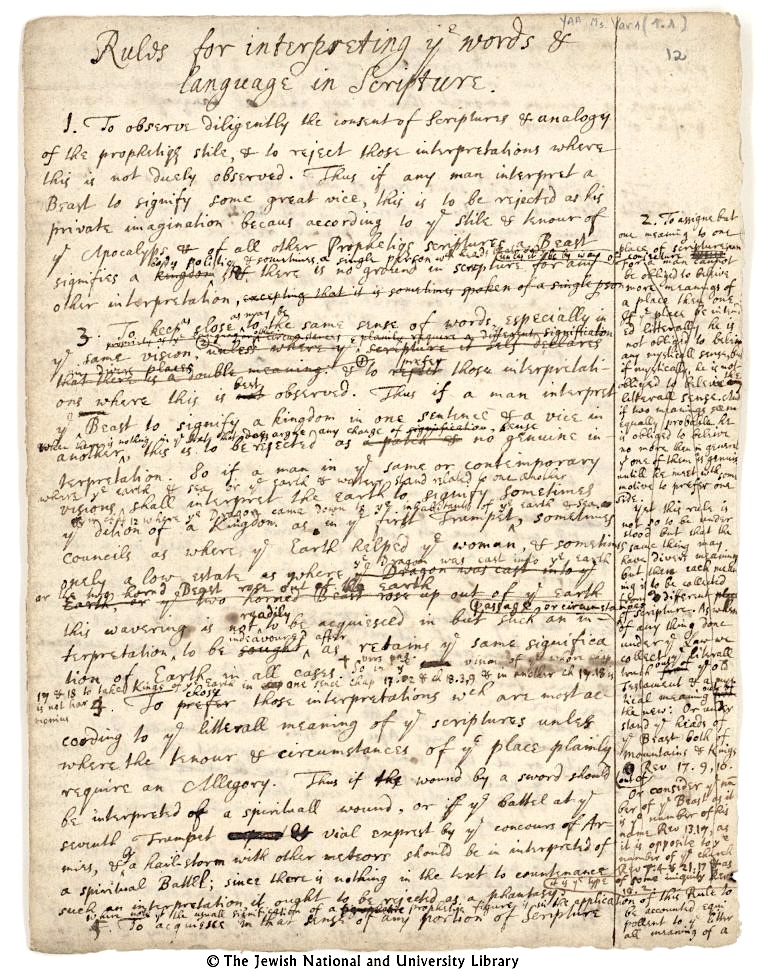
Yet even in this maelstrom of heterodox thought and practices, Sir Isaac Newton stood out as a particularly odd co-existence of esoteric biblical prophecy, occult beliefs, and a rigid, formal mathematics that not only adhered to the inductive scientific method, but also expanded its potential by applying general axioms to specific cases.
Yet many of Newton’s general principles would seem totally inimical to the naturalism of most physicists today. As he was formulating the principles of gravity and three laws of motion, for example, Newton also sought the legendary Philosopher’s Stone and attempted to turn metal to gold. Moreover, the devoutly religious Newton wrote theological treatises interpreting Biblical prophecies and predicting the end of the world. The date he arrived at? 2060.
So then the time times & half a time are 42 months or 1260 days or three years & an half, recconing twelve months to a yeare & 30 days to a month as was done in the Calendar of the primitive year. And the days of short lived Beasts being put for the years of lived [sic] kingdoms, the period of 1260 days, if dated from the complete conquest of the three kings A.C. 800, will end A.C. 2060. It may end later, but I see no reason for its ending sooner.
Newton further demonstrates his confidence in the next sentence, writing that his intent, “though not to assert” an answer, should in any event “put a stop the rash conjectures of fancifull men who are frequently predicting the time of the end.” Indeed. So how did he arrive at this number? Newton applied a rigorous method, that is to be sure.
If you have the patience for an exhaustive description of how he worked out his prediction using the Book of Daniel, you may read one here by historian of science Stephen Snobelen, who also points out how widespread the interest in Newton’s odd beliefs has become, reaching across every continent, though scholars have known about this side of the Enlightenment giant for a long time.
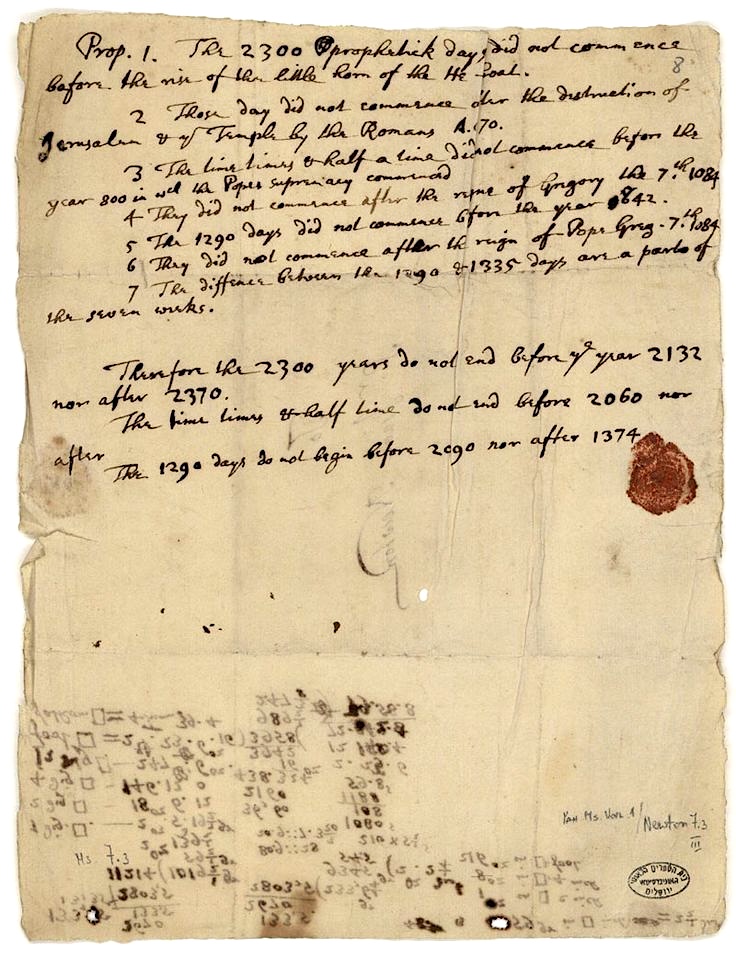
For a sense of the exacting, yet completely bizarre flavor of Newton’s prophetic calculations, see another Newton letter at the top of the post, transcribed below.
Prop. 1. The 2300 prophetick days did not commence before the rise of the little horn of the He Goat.
2 Those day [sic] did not commence a[f]ter the destruction of Jerusalem & ye Temple by the Romans A.[D.] 70.
3 The time times & half a time did not commence before the year 800 in wch the Popes supremacy commenced
4 They did not commence after the re[ig]ne of Gregory the 7th. 1084
5 The 1290 days did not commence b[e]fore the year 842.
6 They did not commence after the reigne of Pope Greg. 7th. 1084
7 The diffence [sic] between the 1290 & 1335 days are a parts of the seven weeks.
Therefore the 2300 years do not end before ye year 2132 nor after 2370.
The time times & half time do n[o]t end before 2060 nor after [2344]
The 1290 days do not begin [this should read: end] before 2090 [Newton might mean: 2132] nor after 1374 [sic; Newton probably means 2374]
The editorial insertions are Professor Snobelen’s, who thinks the letter dates “from after 1705,” and that “the shaky handwriting suggests a date of composition late in Newton’s life.” Whatever the exact date, we see him much less certain here; Newton pushes around some other dates—2344, 2090 (or 2132), 2374. All of them seem arbitrary, but “given the nice roundness of the number,” writesMotherboard, “and the fact that it appears in more than one letter,” 2060 has become his most memorable dating for the apocalypse.
It’s important to note that Newton didn’t believe the world would “end” in the sense of cease to exist or burn up in holy flames. His end times philosophy resembles that of a surprising number of current day evangelicals: Christ would return and reign for a millennium, the Jewish diaspora would return to Israel and would, he wrote, set up “a flourishing and everlasting Kingdom.” We hear such statements often from televangelists, school boards, governors, and presidential candidates.
As many people have argued, despite Newton’s conception of his scientific work as a bulwark against other theologies, it ultimately became a foundation for Deism and Naturalism, and has allowed scientists to make accurate predictions for hundreds of years. 20th century physics may have shown us a much more radically unstable universe than Newton ever imagined, but his theories are, as Isaac Asimov would put it, “not so much wrong as incomplete,” and still essential to our understanding of certain fundamental phenomena. But as fascinating and curious as Newton’s other interests may be, there’s no more reason to credit his prophetic calculations than those of the Millerites, Harold Camping, or any other apocalyptic doomsday sect.
Note: An earlier version of this post appeared on our site in 2015.
We're hoping to rely on loyal readers, rather than erratic ads. Please click the Donate button and support Open Culture. You can use Paypal, Venmo, Patreon, even Crypto! We thank you!
Open Culture scours the web for the best educational media. We find the free courses and audio books you need, the language lessons & educational videos you want, and plenty of enlightenment in between.